From Greed to Grace: How Abel Jimenez Built a Faith-Centered Consulting Practice on the Lessons He Learned the Hard Way

The Message He Didn't Want to Hear
Abel Jimenez had every reason to say no. The startup had hurt people — financially, emotionally — and he had been among them. When God began impressing on him to re-engage with the technology from that failed venture, Abel pushed back hard. "I told God, I don't want to work with these people," he recalls. "But I said, I need to be obedient."
That tension — between what we want and what God asks — is familiar territory for most leaders. What makes Abel's story worth telling is what happened next: not a tidy miracle, but a winding road of obedience, detour, failure, and ultimately, transformation. It's the kind of story that doesn't get shared often enough in business circles, which is exactly why it needs to be.
Structure, Governance, and a Deeper Calling
Abel is the founder of SGA Praxis — Structure, Governance, and Automation — a consulting firm built around helping leaders and organizations solve problems, improve performance, and turn strategy into action. The name reflects the technical rigor he's developed across decades of work in technology, project management, supply chain, and organizational change. He has led large-scale transformations for major organizations, navigating the kind of complexity that breaks lesser teams.
But the professional resume only tells part of the story. "Kingdom Focus represents something even deeper for me," Abel explains. "It's the recognition that our careers, businesses, relationships, experiences, and influence all come together for a purpose." SGA Praxis isn't just a consulting firm. For Abel, it's the vehicle through which he is connecting his past to his future — and offering the hard-won lessons of both to the leaders he serves.
"The more things change, the more you need to rely on the things that never change. God is the biggest one."
That insight comes from one of his mentors, and Abel has made it a cornerstone of how he operates. In a world where artificial intelligence, market disruption, and constant change pressure leaders to react faster and faster, Abel is building a practice anchored in what doesn't move: trust, honesty, relationships, and integrity. "There is no time to build relationships anymore," he observes. "Everything is transactional." His work is, in part, a counter-cultural resistance to that reality.
The Lesson That Cost Him Everything in the Short Term
When Abel created a business entity in response to God's prompting — only to have the original purpose fall through — he didn't dissolve it. He pivoted. He began reselling products on Amazon, built the operation steadily, and eventually had $150,000 worth of inventory moving at a time, generating $4,000 to $5,000 in monthly profit. It was working. And then he found the baseboard heaters.
Brand new inventory, donated to a Habitat for Humanity store by a company that had gone out of business. Priced at fifty dollars. Selling on Amazon for five hundred. The math looked perfect. The logic felt airtight. And Abel knew exactly what Amazon's chain-of-custody policy required — and knew the receipt from Habitat for Humanity wouldn't satisfy it.
He fabricated an invoice anyway. He altered a price tag to make the deal look better than it was. He submitted documentation he knew to be false.
"I lied," he says plainly. "Not only did I stop what God was telling me, I used the company I had created for greed — to earn more money. I did something I shouldn't have."
Amazon flagged the account. His entire inventory was treated as suspect and destroyed. His selling privileges were revoked. The financial loss was significant — and the spiritual cost was even more clarifying.
"It doesn't matter how small the action you need to take — it should always be the right action. That lesson now stays with me in everything I do."
What strikes Abel most in retrospect is how incremental the compromise felt at the time. It wasn't dramatic. It was one document, one altered number, one rationalization. But the trajectory of small dishonesties, he learned, leads somewhere you don't want to go. "I go back now and make sure I am saying exactly what I mean — not trying to deceive anyone in any way." That discipline, forged in a painful loss, has become one of the defining commitments of his professional life.
Accountability as a Spiritual Practice
Abel doesn't share this story reluctantly. He believes in the power of confession — not just as a theological practice, but as a leadership practice. "Speaking it, telling people about it — that's in the Bible too," he notes. "Confessing your sins is also a healing process."
He frames his entire career now through the lens of training. "As believers in Jesus Christ, we're here to be trained for what we're going to be doing in eternity. I look back at many areas of my life — I am in training, and I'm going to keep being in training until God calls me for his service."
Earlier in his career, Abel admits the focus was different. "It was about advancement — and in some cases, sacrificing relationships to make sure the project or my boss or I would move ahead." That changed gradually, and it changed because of his faith. When he encounters conflict now, he goes to scripture before he goes anywhere else. He addresses it directly rather than letting it fester. He takes the plank out of his own eye first. These aren't just good communication strategies — for Abel, they are acts of obedience.
When Loss Becomes Purpose
The season that reoriented Abel's giving came through grief. His aunt passed away. Then, as he reached out to his professional network, he discovered that many of the mentors who had shaped him — at GE, at Schneider Electric, at other companies across his career — had also passed. He never got to thank them.
Then his youth pastor died. "He came into my life when my parents were going through a divorce and took over for four or five years of my life and my siblings' lives," Abel says quietly. "Having them gone — I realized I need to do something. There are so many people who poured so much into me. It is my time now to give back."
He wrote a book — partly to explain what his consulting firm does, but more importantly to pass on the lessons he had learned. "You don't need to hire me. Just read the book and you have your own consultant." A missionary read it and came back with a challenge: could he do the same thing for missions, stripped of all the corporate jargon?
Abel responded by building a free AI-powered application that helps missionaries and churches prioritize initiatives, create operational plans, and access downloadable templates — all at no cost and with language any team can understand. People are using it. Feedback is coming in.
More recently, he began working with Clarity, an organization serving women navigating unexpected pregnancies. He's donating his operations expertise — less paperwork, better follow-through, increased father involvement — because, as he says, "one life saved is important." He's also been invited to expand a technical missions conference into Latin America in 2027.
"I no longer look at these initiatives as money-making opportunities. I look at the number of people they're going to impact and the lives that could be saved. That's how I make my contribution decisions now."
What He Would Tell You Right Now
If you are a Christian business leader trying to figure out how your faith and your work fit together — especially when the fit isn't clean — Abel's advice is straightforward: get involved, and bring the real story.
"Your story doesn't have to be perfect. Mine wasn't," he says. "In fact, the struggles and mistakes, the lessons and the moments when God redirected you — those may be the most valuable parts someone else could benefit from. Someone else may need to hear exactly what God has taught you."
That is the animating vision behind the Kingdom Factor Collective: not a gathering of people who have it all figured out, but a body of believers bringing their whole stories — scars included — to build something together that none of them could build alone.
Abel Jimenez is proof that the path from ambition to purpose isn't straight, and that's not a problem. That's the training."
Written by
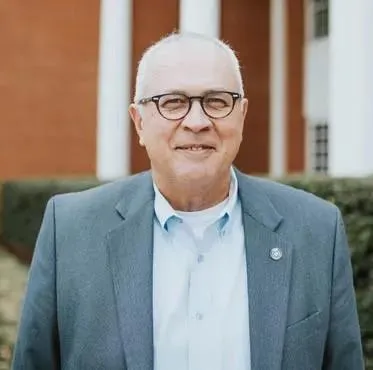
Abel Jimenez
Kingdom Factor Coach helping leaders integrate faith and business for lasting impact.
Interview with
Abel Jimenez
Consultant at SGA Praxis
Continue Reading
More articles in Faith in Business
 Faith in Business
From Lawns to Legacy: How Rubin Anderson Built a Business on Faith, Not Opportunity
.jpg) Faith in Business
Faith in BusinessIron Sharpens Iron: How Jeremy Vesta Leads with Faith Through Market Storms and Marketplace Pressure
Curally COO Jeremy Vesta has weathered brutal commodity cycles, corporate culture clashes, and high-stakes decisions — and he'll tell you the most valuable thing he gained wasn't a deal. It was a deeper faith.

.jpg) Faith in Business
Faith in BusinessFrom Philosophy to Plant Floor: How Matt Hatfield Is Calling Christian Leaders Back to the Mission Field at Work
Matt Hatfield spent decades watching faith get left at the office door — by believers and non-believers alike. Now he's doing something about it.

WANT TO SHARE YOUR STORY?
Join our community of faith-driven leaders and share how God is working in your business.
Get Started